

.jpeg)
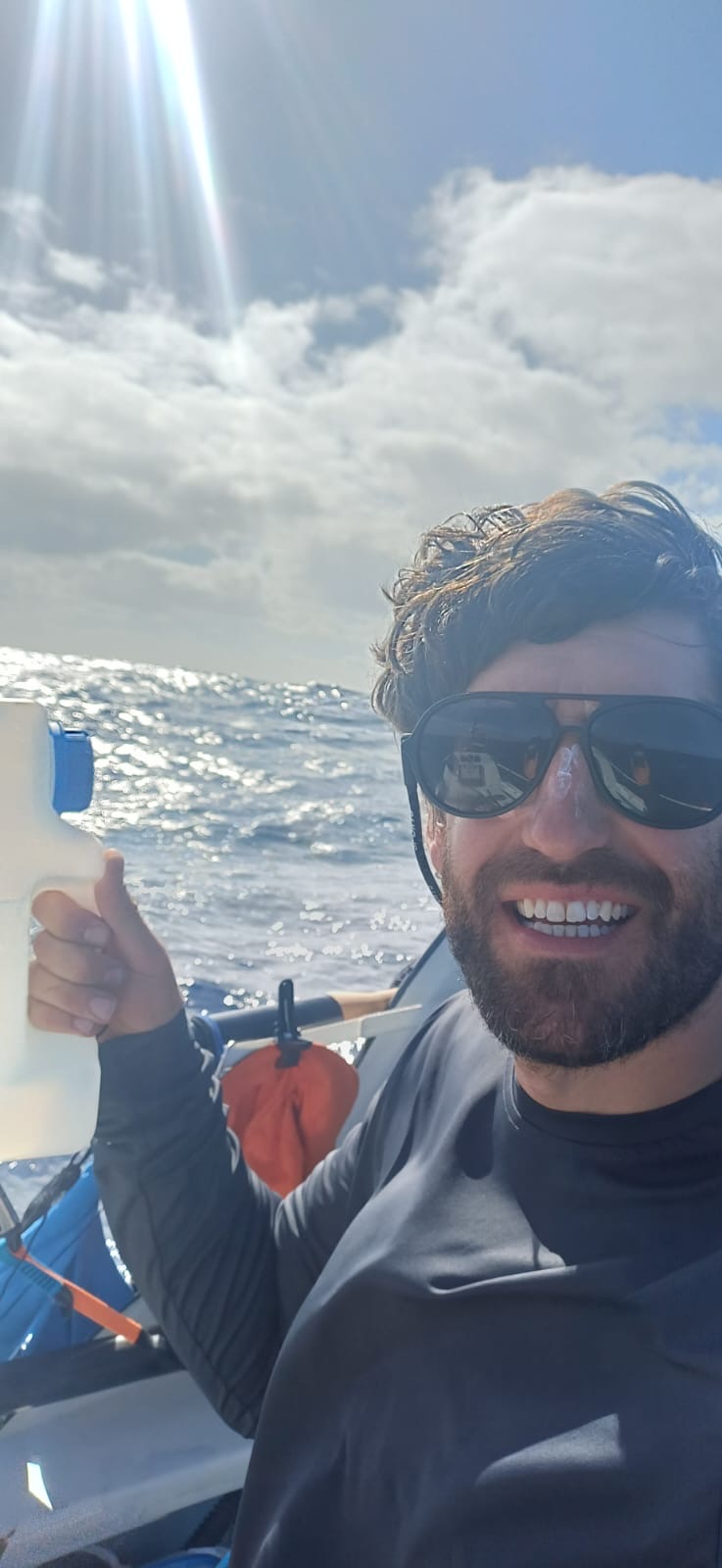
The start of the race has been every bit as challenging as I expected it might be.
The feedback coming in is that many teams are struggling too, mostly with seasickness.
We’ve all spent countless hours training on our boats, including full 24-hour stints rowing through the night, so everyone here is as prepared as they reasonably can be.
Yet the environment still comes as a shock to the body.
On the first night, battling the nausea and constant motion, I felt so much worse whenever I went into the cabin. In the end, I slept on the deck instead.
That meant getting regularly splashed by waves, so not only was I seasick, I was also cold and wet.
I’ve never experienced seasickness before, but I now have a deep appreciation for just how unpleasant it can be.
In the middle of all this adjusting, you’re still asking your body to burn the equivalent of 5000 calories a day just rowing.
But thanks to seasickness, you might only be managing to take in a fraction of that.
In my case, closer to 500 calories a day for the first few days.

While rowing today—feeling nauseous, weak, and frankly miserable—I found myself thinking about a conversation I once had with someone suffering from long COVID.
They told me they were now largely wheelchair-bound and could only walk about 50 metres at a time.
Long COVID is a devastating condition: poorly understood, varied in how it affects people, and still with limited research. Everyone’s situation is different.
But I remember wondering, hypothetically, whether it might be possible for them to walk 60 metres one week, then 70 the next, slowly building up over time.
To reach a point where they could say ‘the average person in my situation can walk 50 metres, but I can walk 100’.
I have no idea whether that’s medically realistic—but the principle stuck with me.
According to official race requirements, I’m supposed to be eating 7200 calories a day.
Realistically, given my body weight, I probably don’t need quite that much—perhaps closer to 5000 or 6000—but even that feels impossible at the moment.
So I asked myself the same question: what’s the one thing I can do?
I decided my goal for the day would be simple.
Eat one proper meal—not just snacks, which are easier to tolerate, but one of the ration packs I’m meant to eat.
Today’s choice was fish pie. Not glamorous, but it contained about 1200 calories.
I can’t eat 6000 calories today. But I can eat closer to 1500.
And I did. It stayed down. And I feel noticeably better for it.
That’s the lesson I keep coming back to, no matter how overwhelming or difficult the task ahead feels, there is always something you can do.
If you can’t manage the full goal, find the smallest version of it that’s within reach.
Not exactly ideal conditions—but for now, it’s part of the process.
Tomorrow, I’ll focus on finding the next small thing I can do.


